


No one tells you if you’re bad at interviewing.
The recruiter won’t call back and say, “Hey, you bombed that one.” The hiring manager won’t explain what they were looking for or whether you had it. You’re left guessing. And that’s a problem, because I might have the skills but not know how to talk about them.
So I built a system to get feedback despite that.
The Setup
I use two tools: Granola and Cursor.
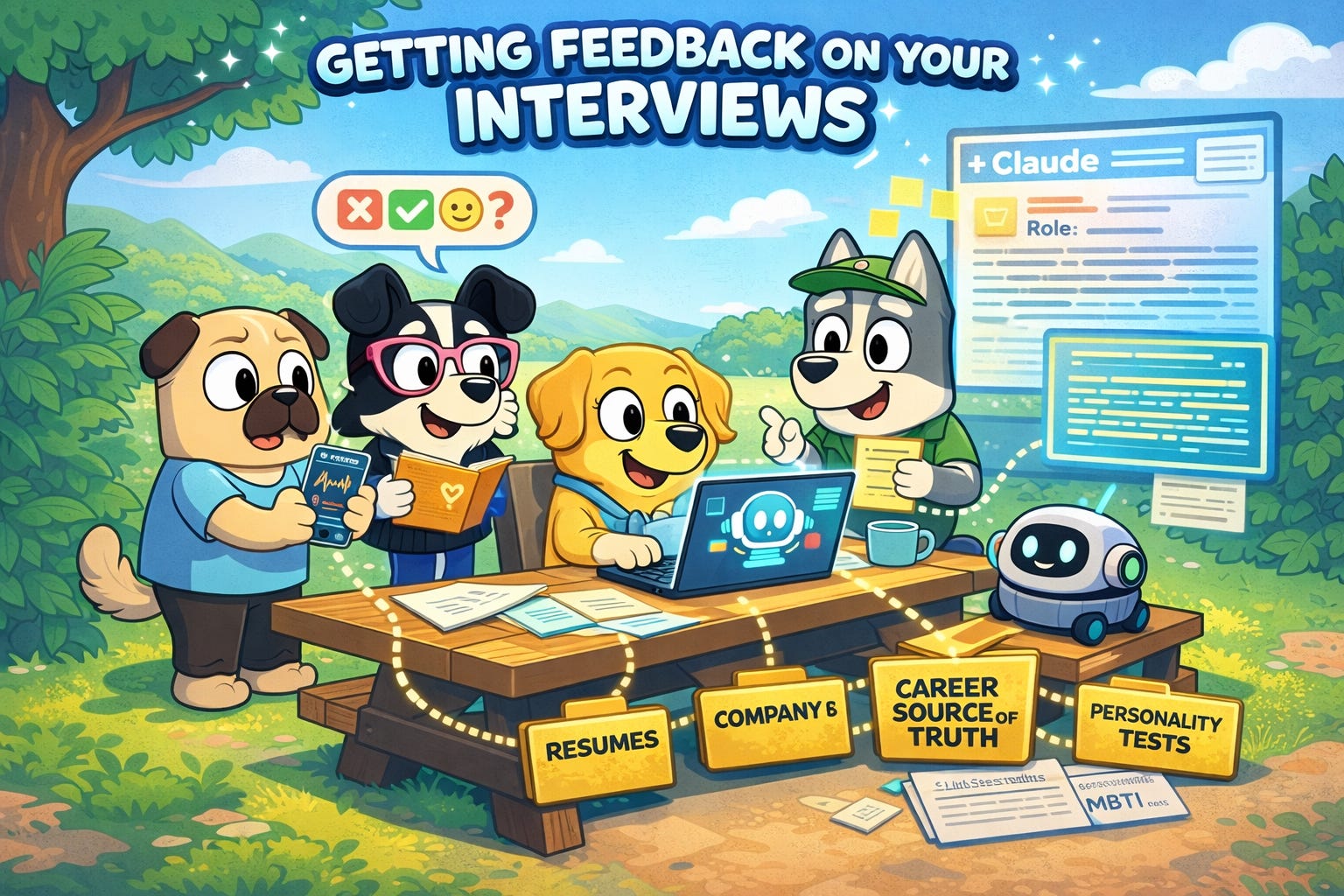
Granola records and transcribes my interviews. Once I have the transcript, I bring it into Cursor along with a bunch of other context: my resume, the job description, notes on the company, and something I call my Career Source of Truth.
Why Cursor?
Because it lets me give Claude Code all the context it needs. The job. The company. The interviewer. My full career history. The actual conversation. With all of that in one place, Claude can give me real feedback on how the interview went.
The Career Source of Truth
Here’s the thing about my career: it hasn’t always been pretty.
I’ve had bosses I liked and bosses I hated
I’ve had roles I loved and roles I tolerated
I’ve worked at companies I’m proud of and companies I’m not
All of that matters. But I’m not going to say it in an interview. In an interview, I’m the product. I’m selling myself as the solution to their problem. I don’t lead with the flaws. Nobody selling a phone tells you about the bad battery life. I focus on the highlights. There’s nothing wrong with that.
Here’s how I built my Career Source of Truth:
I talk through my whole career out loud using a tool like Wispr Flow. Every job. Every boss. Every win and every failure.
I dump all of that into an LLM and ask it to ask me more questions until we have a full picture.
I save that document and upload it to Cursor.
I’ve also added sections with prepared stories for common interview questions. I know what types of questions I’ll get for product and growth roles. Having those stories ready makes a huge difference.
The File Structure
Here’s the folder structure I use. Copy it and make it your own:
📁 job-search/
├── 📁 .claude/                     # Claude Code settings (optional)
├── 📁 interview-transcripts/
│   ├── 📁 company-a/
│   │   ├── job-description.txt
│   │   ├── company-research.txt
│   │   ├── interviewer-profile.txt
│   │   ├── recruiter-screen.txt
│   │   ├── hiring-manager-interview.txt
│   │   └── technical-interview.txt
│   ├── 📁 company-b/
│   │   └── ...
│   └── 📁 company-c/
│       └── ...
├── 📁 resumes/
│   ├── base-resume.txt
│   ├── growth-pm-version.txt
│   ├── core-pm-version.txt
│   └── hybrid-version.txt
├── career-source-of-truth.txt
├── drivers-and-drainers.txt
└── personality-assessments.pdf      # CliftonStrengths, MBTI, etc.
What goes where:
interview-transcripts/ : One subfolder per company. Job descriptions, research, interviewer profiles, and transcripts from each conversation.
resumes/ : Different versions of your resume for different role types.
career-source-of-truth.txt : Your full career history, including the stuff you wouldn’t say out loud.
drivers-and-drainers.txt : What gives you energy vs. what drains you.
personality-assessments.pdf : Optional, but useful for feedback on role fit.
Career Source of Truth Template
Here’s a template you can copy. The goal is to create an honest record of your career that you can pull from when prepping.
markdown
CAREER SOURCE OF TRUTH
======================
Last updated: [Date]

Purpose: Unbiased record of career history, accomplishments, and context.
Use this to pull details for resumes, cover letters, and interview prep.

========================================================================
[COMPANY NAME] ([Start Date] - [End Date])
========================================================================

COMPANY CONTEXT
- What does the company do?
- Stage/size (Series A, public, etc.)
- Approximate headcount
- How did you leave? (quit, laid off, etc.)

REPORTING STRUCTURE
- Who did you report to? (title and name)
- What was the relationship like? (good, bad, micromanager, hands-off)

TEAM
- Direct reports? How many?
- Cross-functional collaborators?
- What functions did you work with most?

TOOLS
- Analytics, experimentation, product tools
- Other relevant tech

KEY PROJECTS

[Project Name]:
- Problem: What was broken or missing?
- Solution: What did you do?
- Your role: What did YOU own?
- Result: Quantified outcome (%, $, time saved, etc.)

KEY METRICS
- List your most impressive numbers
- Tie them to business outcomes where possible

STAKEHOLDER CHALLENGES
- Any notable conflicts or alignment issues?
- How did you resolve them?

WHY YOU LEFT
- Be honest, this is for your reference

HOW YOU FELT ABOUT THE ROLE
- What did you like? What did you hate? Would you go back?

========================================================================
[REPEAT FOR EACH ROLE]
========================================================================

========================================================================
EDUCATION & CERTIFICATIONS
========================================================================
- School, degree, dates
- Relevant coursework or skills learned
- Online courses, bootcamps, certifications

========================================================================
SKILLS & TOOLS
========================================================================
- Technical (languages, platforms)
- Analytics tools
- Product tools
- AI/prototyping tools

========================================================================
PERSONAL CONTEXT
========================================================================
- Location, relocation preferences
- Family context relevant to career decisions
- Interests and side projects that demonstrate skills

========================================================================
CAREER NARRATIVE THEMES
========================================================================

Use this section to identify patterns across your career:

PATTERN: [Theme name]
- Evidence from Role 1
- Evidence from Role 2
- Why this matters

Examples of patterns to look for:
- Promoted fast
- Self-directed learner
- Types of work you gravitate toward vs. avoid
- Recurring strengths and challenges

========================================================================
INTERVIEW Q&A - PREPARED ANSWERS
========================================================================

TOP STORIES (have 5-6 ready):
1. [Story name] > [Key metric] ([Category])
2. [Story name] > [Key metric] ([Category])
3. [Story name] > [Key metric] ([Category])

WORDS/PHRASES TO STOP SAYING:
- [Filler words you overuse]
- [Weak phrases]

WORDS/PHRASES TO START SAYING:
- "I owned..."
- "I drove..."
- "The result was..."

========================================================================
COMMON QUESTIONS CHEAT SHEET
========================================================================

Q: Tell me about yourself
> [Your 30-second pitch]

Q: Why this role?
> [Your answer]

Q: Tell me about a project you led
> [Your go-to story]

Q: Tell me about a failure
> [Your story, own it, show learning]

[Add more questions specific to your field]

========================================================================
STORIES BY THEME - QUICK REFERENCE
========================================================================

[THEME 1: e.g., Cross-functional collaboration]:
> [Story + key metric]

[THEME 2: e.g., Data-driven decisions]:
> [Story + key metric]

[YOUR WEAK SPOT, have stories ready]:
> [Story that addresses the gap]

========================================================================
THINGS TO AVOID SAYING
========================================================================
- [Topics or phrases that don't land well]
- [Anything that raises red flags]
How I Use It
Once I have all this context in place, I ask Claude: “Here’s my most recent interview. Based on the job description, company info, interviewer background, my resume, and my Career Source of Truth: how did this go? What went well? What didn’t land?”
Claude gives me real feedback. What I did well. What fell flat. Moments where I could have said something different.
Where This Shines
This works for single interviews. But it gets powerful when I stack up multiple interviews, either multiple rounds at one company or similar roles across different companies.
Claude can:
Spot trends across interviews (”When you say X, people respond well. When you say Y, it falls flat.”)
Help me prepare for likely questions based on patterns
Dig into my Career Source of Truth and say, “Someone asked you this question and you didn’t have a good answer. But you have a perfect story for it. Here’s how to frame it.”
I’ve also uploaded my CliftonStrengths assessment. Claude can read it and tell me my top strengths and blind spots. I have a separate doc with my drivers and drainers: what gives me energy and what depletes it. With all that context, Claude can tell me which roles I’ll thrive in and which ones will drain me.
Evaluating Them, Not Just Selling Yourself
Here’s an underrated benefit: Claude helps me evaluate companies, not just pitch myself.
It might say, “Company X looks great on paper, but there are red flags in these transcripts. In your next interview, dig into this topic that seems unresolved.”
That’s huge. It helps me ask better questions. It helps me judge whether a company is a good fit for me, not just whether I can convince them I’m a fit for them.
Bringing It Home
This system has been a game changer: a file structure with all my context, an LLM that can analyze multiple interviews, and feedback that’s (hopefully) unbiased.
This matters to me because I get imposter syndrome. I think, “I can do this job. But I don’t know if I speak the language. I don’t know if I can sell myself for this role, even though I have the experience.”
This system helps me frame my skills the right way. I know what I’ve done. Claude helps me shape it for the person I’m talking to. Because I have to tell different stories to different people. Design, marketing, product, engineering, executives: they all want to hear the same story, but with the right angle. Good PMs are persuasive. You tell the same story in a way that lands with each audience.
I’m not pushing fraud or deception. But in interviews, I often have the experience. I just don’t know how to talk about it in a way that clicks with the person across the table.
This system fixes that.